 I
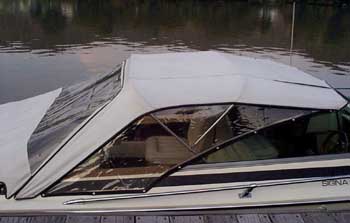
thought about making canvas running covers to replace the original vinyl ones,
but since the vinyl covers still work, I just never did.
I
thought about making canvas running covers to replace the original vinyl ones,
but since the vinyl covers still work, I just never did.The Next Chapter
Most of what I've written about so far has had to do with repairs and maintenance, so I didn't write anything in 2005 or 2006 because no serious maintenance or repairs were required. I replaced all the fuel lines in the Spring of 2005, and not a moment too soon from the look of the old ones. I also added a Keel Guard, which is a rubber strip that protects the boat's keel from getting bunged up when it's grounded on a beach or, in my case, banged into the trailer while loading. Other than that, it was just routine oil changes and cleaning in between enjoying riding around in the boat.
I
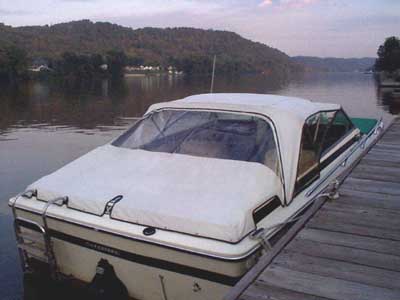
thought about making canvas running covers to replace the original vinyl ones,
but since the vinyl covers still work, I just never did.
Same thing with the upholstery. It would have been nice to upgrade and update it and get the boat looking really sharp, but it works as it is, and it isn't really in bad shape, so I never bothered.
I learned that about three weeks was the maximum time I could leave the boat docked in the water without cleaning becoming a real chore. And I found that the public ramp at St Albans had an angle that made it much easier to get my boat on and off its trailer than the Poca ramp. Even though it's a little farther from home, it was worth the trip for the easier loading. I began hauling the boat out of the water more frequently to keep the bottom clean and keeping it on land during rainy spells.
Also during this time, I learned the value of spring lines to help keep the boat from getting knocked around too much by wakes at the dock. We get a lot of people going by in large motor cruisers on my area of the river, and some of them don't seem to realize that when they're plowing along near the bank throwing up a three foot high wake, those of us who live along the bank aren't generally appreciative. I've considered mooring whips, but haven't yet managed to justify their expense.
 I
bought an aluminum prop to help reduce galvanic corrosion, and also found some
magnesium anodes to replace my zinc ones. This combination was effective. With
the original stainless steel prop and zinc anodes, I'd start seeing white
powdery corrosion forming on the aluminum parts after a couple weeks in the
water. With the new prop and anodes, I could devote my haul-out time to cleaning
the muck off the boat's bottom and wasn't having to put much effort into keeping
the outdrive free of corrosion. The price was about five to ten MPH of top
speed. Since I seldom ride around at top speed, this wasn't too much of a
problem for me. Acceleration didn't seem to be noticeably affected, probably due
to the Mercruiser 165's tractor-like torque. A friend told me that the 165 had
always been his favorite powerplant for water skiing. While not the most
powerful engine around, it's broad torque range made it ideal for pulling a
skier up out of the water without jerking his arms out of their sockets.
I
bought an aluminum prop to help reduce galvanic corrosion, and also found some
magnesium anodes to replace my zinc ones. This combination was effective. With
the original stainless steel prop and zinc anodes, I'd start seeing white
powdery corrosion forming on the aluminum parts after a couple weeks in the
water. With the new prop and anodes, I could devote my haul-out time to cleaning
the muck off the boat's bottom and wasn't having to put much effort into keeping
the outdrive free of corrosion. The price was about five to ten MPH of top
speed. Since I seldom ride around at top speed, this wasn't too much of a
problem for me. Acceleration didn't seem to be noticeably affected, probably due
to the Mercruiser 165's tractor-like torque. A friend told me that the 165 had
always been his favorite powerplant for water skiing. While not the most
powerful engine around, it's broad torque range made it ideal for pulling a
skier up out of the water without jerking his arms out of their sockets.
 We
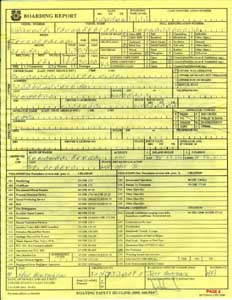
did our usual boating activities for the summers of '05 and '06, the occasional trip to Charleston, and a lot
of puttering around near home. On one occasion I was out with some friends for a
day on the water and we were pulled over by the Coast Guard near Poca. They
asked for my registration and ID, and it occurred to me that I'd been out in my
boat many times without any ID on me. Fortunately I had it this time. They
checked my life preservers and fire extinguisher and a few other things, warned
us of the dangers of demon alcohol, and let us go on our way.
We
did our usual boating activities for the summers of '05 and '06, the occasional trip to Charleston, and a lot
of puttering around near home. On one occasion I was out with some friends for a
day on the water and we were pulled over by the Coast Guard near Poca. They
asked for my registration and ID, and it occurred to me that I'd been out in my
boat many times without any ID on me. Fortunately I had it this time. They
checked my life preservers and fire extinguisher and a few other things, warned
us of the dangers of demon alcohol, and let us go on our way.
I traded in my old Taurus wagon for a Toyota Camry in the Spring of 2006, leaving me without a tow vehicle, but closer to my goal of having an efficient car to drive to work and stout truck to tow the boat. The only thing missing was the truck. That changed in August of '06 when a friend told me about an F150 that an engineering company in St Albans had for sale. It had high mileage, but had been scrupulously maintained and the price was right, so I bought it. It had been a survey crew truck, and most of its miles were highway driving, going to and from job sites. I installed a trailer hitch and transmission cooler and found a set of SUV wheels and tires to replace the loud and bumpy mud grips that came on it. It pulls the boat around with considerably more aplomb than the old station wagon did.
 Although
nothing had gone wrong in a long while, and I was enjoying messing about in my
boat, I was coming to the conclusion that this type of boat isn't well suited to
my use. I needed something that could sit in the water all or most of the summer
and be convenient to use whenever I felt like it. For a trailer boater who would haul
it to the water for use and keep it snug and dry on the trailer the rest of the
time, the old Thunderbird would give good service. But trying to keep it in the
water had me constantly occupied with the prevention of drive corrosion and wood
rot.
Although
nothing had gone wrong in a long while, and I was enjoying messing about in my
boat, I was coming to the conclusion that this type of boat isn't well suited to
my use. I needed something that could sit in the water all or most of the summer
and be convenient to use whenever I felt like it. For a trailer boater who would haul
it to the water for use and keep it snug and dry on the trailer the rest of the
time, the old Thunderbird would give good service. But trying to keep it in the
water had me constantly occupied with the prevention of drive corrosion and wood
rot.
I began thinking about sailboats during the summer of 2006. The fact that I didn't know anything about sailing was a bit of a problem, but one day after putting my boat in at St Albans, I watched two sailors sailing their sailboats on the river and began to think of the idea of owning a sailboat as a practical one. (I hope you can excuse the use of the words "boat" and "practical" in the same sentence.) In October of 2006, I saw a 1986 Gloucester 20 for sale on eBay. I was a little surprised that it didn't sell, since I'd seen similar boats on eBay go for more than what this seller was asking. A few weeks later, I ran across the seller in an online discussion group and asked if she still had the boat for sale. She did and I arranged a trip to Dayton, about three hours drive time, to have a look at it. In November of 2006, I became the owner of two boats.
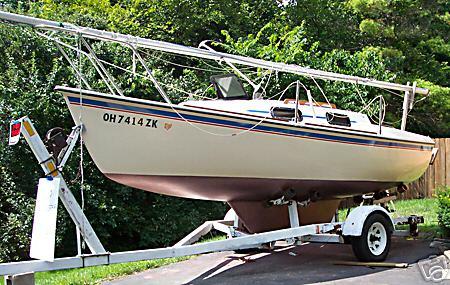 My
sailboat has anti-fouling paint on its bottom, which will make cleanup easier. It has no structural wood components, so I won't have to be continuously
worried about wood rot, and it has an enclosed cabin which makes it quite
a bit more suited to staying out in the weather than my wide open motorboat. The
G20's little 4HP outboard raises completely out of the water when not in use, so
I won't have to concern myself too much with aluminum drive components getting
attacked by galvanic corrosion. It turns out that several of my coworkers are
experienced sailors and the owner of the company was a sailing instructor at one
time. I have several standing offers to teach me how to sail.
My
sailboat has anti-fouling paint on its bottom, which will make cleanup easier. It has no structural wood components, so I won't have to be continuously
worried about wood rot, and it has an enclosed cabin which makes it quite
a bit more suited to staying out in the weather than my wide open motorboat. The
G20's little 4HP outboard raises completely out of the water when not in use, so
I won't have to concern myself too much with aluminum drive components getting
attacked by galvanic corrosion. It turns out that several of my coworkers are
experienced sailors and the owner of the company was a sailing instructor at one
time. I have several standing offers to teach me how to sail.
So the question now is what to do with the Thunderbird. The practical thing would be to sell it, but I kind of hate to part with it after all the work I've done to get it to its present state and all the enjoyment I've gotten out of it. I'll never get another runabout of similar utility and reliability for what I could sell it for. On the other hand, I don't need two boats. But then this whole boat-owning experience hasn't really been about needs, so I'll let the question stand for a while longer.