New Tow Vehicle
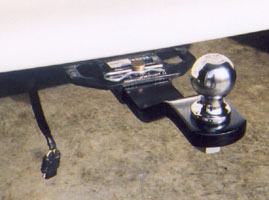 Since I didn't want
to tackle replacing the truck's clutch until I absolutely had to, I bought a
hitch for my Taurus station wagon. The Taurus' larger engine, greater weight,
and four wheel disk brakes made it a better tow vehicle than my little truck
anyway. It may not be ideal but as long as all I have to do is
tow the boat about ten miles to and from the ramp a few times each year, it'll
do. I bought and installed a Reese "Shadow Mount" hitch. This
hitch uses a rectangular draw bar with a pin that goes through vertically to
hold it in the receiver. The instructions show the pin inserted from the top
with the retaining clip on bottom, but the bumper on my wagon wouldn't let it go
in that way. I called Reese and asked if it was safe to put the pin in from the
bottom. The phone support guy said it was. I asked about the possibility of
the retaining clip coming off and letting the pin fall out and he said it's
never happened and reassured me that the only load on the clip is the weight of
the pin itself.
Since I didn't want
to tackle replacing the truck's clutch until I absolutely had to, I bought a
hitch for my Taurus station wagon. The Taurus' larger engine, greater weight,
and four wheel disk brakes made it a better tow vehicle than my little truck
anyway. It may not be ideal but as long as all I have to do is
tow the boat about ten miles to and from the ramp a few times each year, it'll
do. I bought and installed a Reese "Shadow Mount" hitch. This
hitch uses a rectangular draw bar with a pin that goes through vertically to
hold it in the receiver. The instructions show the pin inserted from the top
with the retaining clip on bottom, but the bumper on my wagon wouldn't let it go
in that way. I called Reese and asked if it was safe to put the pin in from the
bottom. The phone support guy said it was. I asked about the possibility of
the retaining clip coming off and letting the pin fall out and he said it's
never happened and reassured me that the only load on the clip is the weight of
the pin itself.
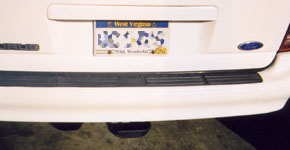 Wiring a light connector on the Taurus was simple enough. The tail light
wiring harness passes through the spare tire well in the left rear corner. I found a
conveniently located grommet to pass the wires through and tapped into the tail
light wiring using the factory service manual that I purchased with the car as a
guide. I tested my handiwork and put everything back together. Later, I was
taking the car out and noticed the power door locks didn't work. The receiver
for the remote entry system is located in the spare tire well where I was
working earlier, so I figured I must have inadvertently done something to that.
I didn't have time to look into it at the time so I continued with my planned
trip.
Wiring a light connector on the Taurus was simple enough. The tail light
wiring harness passes through the spare tire well in the left rear corner. I found a
conveniently located grommet to pass the wires through and tapped into the tail
light wiring using the factory service manual that I purchased with the car as a
guide. I tested my handiwork and put everything back together. Later, I was
taking the car out and noticed the power door locks didn't work. The receiver
for the remote entry system is located in the spare tire well where I was
working earlier, so I figured I must have inadvertently done something to that.
I didn't have time to look into it at the time so I continued with my planned
trip.
On the way, I found that besides the locks, the radio as well as the
interior and dash lights were out. When I got back home, I checked the
schematics and found that all of the non-functioning stuff had a fuse in common
and sure enough it was blown. I opened up the tire well again and started
looking for trouble. I checked my trailer wiring and found that it was all still
working as it should. I checked the manual again verified that the problem
circuit wasn't connected to the tail light circuit.
I checked the problem
circuit at the fuse panel
with my ohm meter and measured only the resistance of the interior light
filaments. Since there was no short, I replaced the fuse. Everything worked, so
I started putting the tire well cover back together but didn't feel good about
it. Fuses don't blow for no reason. As I was shoving in one of those push-in
body fasteners to hold the felt insulation to the outer wall of the tire well,
the fuse blew again.
I looked behind the fastener and there was nothing there. I
stuck my ohm meter back in the fuse panel and found that once again the short was
gone. I wiggled wires around while watching the meter but couldn't recreate the
short. I tried pushing on the side wall to simulate putting the body fastener in
and saw the meter dip. I was onto something, but what?
Eventually I figured out
that when I pushed hard against the side, my head was pushing up on the left
cargo light in the roof. (There's one on each side of the wagon's cargo area.) Finally I had
something that was related to the circuit that was blowing fuses. I found that
pushing up hard on the cargo light would short out the light circuit. I
partially disassembled the light but never figured out exactly why it shorted. I
replaced the fuse and put the tire well back together, being careful not push up
on the light this time. I figured it wasn't worth putting a lot of effort into
short-proofing the cargo lights, since they hadn't been a problem up to now.
Next: Autumn
Index