Canvas Work
 I bought some Sunbrella™ fabric and V92 thread with the idea that I could
use Laura's high-dollar Janome sewing machine for the task. After sewing a few
test pieces, I found that the Janome had no difficulty punching through the
heavy canvas, but didn't have enough range of tension adjustment to make a
proper stitch in it with the heavy thread. Rather than risk damaging the Janome, I dug
out Laura's previous machine, a 70s vintage Singer Athena 2000, to experiment
with. The Singer's lower drive gears were stripped so my first task was to get
some replacements and figure out how to install them and retime the hook and
feed mechanisms. After a little research I gained enough theory of sewing
machine operation to time the Singer and had it back in working order. The next
step was to hot rod the tension mechanism so it would pull a stitch in the fat
V92 thread. I was able to get enough tension for a well balanced stitch, but the
Singer's feed was too weak to pull the heavy fabric through properly and it had
trouble penetrating more than a few layers. Square one was becoming a familiar
place.
I bought some Sunbrella™ fabric and V92 thread with the idea that I could
use Laura's high-dollar Janome sewing machine for the task. After sewing a few
test pieces, I found that the Janome had no difficulty punching through the
heavy canvas, but didn't have enough range of tension adjustment to make a
proper stitch in it with the heavy thread. Rather than risk damaging the Janome, I dug
out Laura's previous machine, a 70s vintage Singer Athena 2000, to experiment
with. The Singer's lower drive gears were stripped so my first task was to get
some replacements and figure out how to install them and retime the hook and
feed mechanisms. After a little research I gained enough theory of sewing
machine operation to time the Singer and had it back in working order. The next
step was to hot rod the tension mechanism so it would pull a stitch in the fat
V92 thread. I was able to get enough tension for a well balanced stitch, but the
Singer's feed was too weak to pull the heavy fabric through properly and it had
trouble penetrating more than a few layers. Square one was becoming a familiar
place.
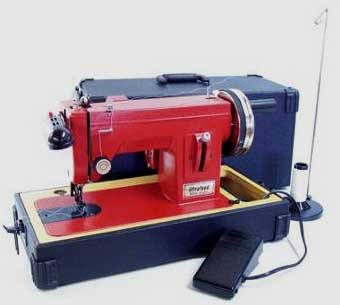 I started shopping for a heavier dutier sewing machine. The standard
non-commercial sewing machine for boat canvas work is the Pfaff 130. It's a
1950s era machine, that's extremely heavily built. I found several on eBay,
and bid on a couple, but as the boating season came on they became increasingly
costly. The Sailrite company of Indiana sells a machine they call the
Ultrafeed,
specifically for boat canvas work. Since the used Pfaffs were approaching the
cost of a new Ultrafeed, I went for the new machine. The Sailrite folks are a
personable and helpful bunch and they sell
their machines on the premise that the owner is going to do his own maintenance
and repairs. They include detailed service information with the Ultrafeed,
unlike most consumer sewing machines whose makers seem to assume that the user
would prefer not to know what goes on inside.
I started shopping for a heavier dutier sewing machine. The standard
non-commercial sewing machine for boat canvas work is the Pfaff 130. It's a
1950s era machine, that's extremely heavily built. I found several on eBay,
and bid on a couple, but as the boating season came on they became increasingly
costly. The Sailrite company of Indiana sells a machine they call the
Ultrafeed,
specifically for boat canvas work. Since the used Pfaffs were approaching the
cost of a new Ultrafeed, I went for the new machine. The Sailrite folks are a
personable and helpful bunch and they sell
their machines on the premise that the owner is going to do his own maintenance
and repairs. They include detailed service information with the Ultrafeed,
unlike most consumer sewing machines whose makers seem to assume that the user
would prefer not to know what goes on inside.
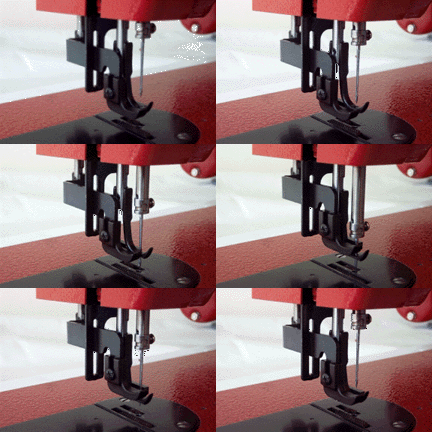 I watched the videos that came with the Ultrafeed and practiced on some test
pieces until I felt confident to start on the cover. By now, the cost of my new
four square yard cover was well into the absurd after factoring in the cost of
the new machine. My sewing machine is a high quality tool, though and I consider
tools a good investment. I expect to be able to use it on a number of other
projects.
I watched the videos that came with the Ultrafeed and practiced on some test
pieces until I felt confident to start on the cover. By now, the cost of my new
four square yard cover was well into the absurd after factoring in the cost of
the new machine. My sewing machine is a high quality tool, though and I consider
tools a good investment. I expect to be able to use it on a number of other
projects.
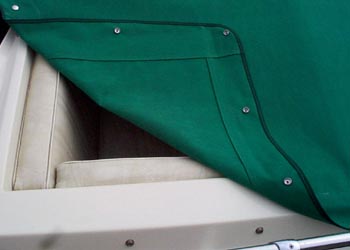
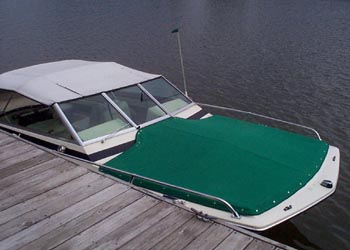 After an unsuccessful attempt to use the original cover as a pattern,
I bought a "Quick-Fit" kit, which consists of a set of snaps with pins
on their backs and retainers that go over the pin after you insert it into the
canvas. After attaching two sections of canvas together with a flat felled seam
to get the necessary width, I put some Quick-Fit fasteners on the mating snaps
on my boat and fit the uncut piece on the boat. After a little adjusting of the
fit over the pins, I was able to mark the piece for an accurate cut. I added
some reinforcements along the edges where the snaps would go and finished the
edge with binding tape. Sailrite has a binding attachment for the Ultrafeed
which probably would have made that part of the job a whole lot easier, but I
didn't get one so I made do by holding the binding in place with basting tape.
After all the sewing was complete, another fitting with the Quick-Fits confirmed the
locations for the real snaps, I hammered them on, and Bob was my uncle.
After an unsuccessful attempt to use the original cover as a pattern,
I bought a "Quick-Fit" kit, which consists of a set of snaps with pins
on their backs and retainers that go over the pin after you insert it into the
canvas. After attaching two sections of canvas together with a flat felled seam
to get the necessary width, I put some Quick-Fit fasteners on the mating snaps
on my boat and fit the uncut piece on the boat. After a little adjusting of the
fit over the pins, I was able to mark the piece for an accurate cut. I added
some reinforcements along the edges where the snaps would go and finished the
edge with binding tape. Sailrite has a binding attachment for the Ultrafeed
which probably would have made that part of the job a whole lot easier, but I
didn't get one so I made do by holding the binding in place with basting tape.
After all the sewing was complete, another fitting with the Quick-Fits confirmed the
locations for the real snaps, I hammered them on, and Bob was my uncle.
 Finally, in June the weather began to improve. I changed the oil in both
the engine and drive unit, tightened the drain valves, and prepared for a test
run. With the ear muffs on and water running, I turned the key and after a
little cranking, which was probably needed to refill the carburetor bowl which I
had drained in the Fall, the engine started. I ran it briefly, watching the
gauges, and shut down and checked for any signs of trouble. Not finding any, I
restarted and let the engine get up to operating temperature. It stabilized at
its usual point, just shy of 150° on my gauge. The starter responded to each
turn of the key, raising hope that replacing the battery cable may have resolved
that problem.
Finally, in June the weather began to improve. I changed the oil in both
the engine and drive unit, tightened the drain valves, and prepared for a test
run. With the ear muffs on and water running, I turned the key and after a
little cranking, which was probably needed to refill the carburetor bowl which I
had drained in the Fall, the engine started. I ran it briefly, watching the
gauges, and shut down and checked for any signs of trouble. Not finding any, I
restarted and let the engine get up to operating temperature. It stabilized at
its usual point, just shy of 150° on my gauge. The starter responded to each
turn of the key, raising hope that replacing the battery cable may have resolved
that problem.
Next: Back in the Water
Index