Back in the Water
 It
seemed as if it was never going to stop raining, but eventually we got a dry
weekend and I hitched the
boat to the back of my Taurus, towed it to Poca and launched. Everything
went well, except for a tendency to turn left. I must have misadjusted the trim
tab when I reinstalled it. There was also a problem with the speedometer which
turned out to be a loose connection to the pitot tube. The tubing that connects
the pitot to the speedometer had shrunk over the years. I could force it back in
place, but it would pop right back off. I cut the tubing a few inches above the
pitot and inserted an automotive vacuum hose splice fitting that I happened to
have on hand. This gave me the extra quarter inch or so that I needed to get it
to stay in place.
It
seemed as if it was never going to stop raining, but eventually we got a dry
weekend and I hitched the
boat to the back of my Taurus, towed it to Poca and launched. Everything
went well, except for a tendency to turn left. I must have misadjusted the trim
tab when I reinstalled it. There was also a problem with the speedometer which
turned out to be a loose connection to the pitot tube. The tubing that connects
the pitot to the speedometer had shrunk over the years. I could force it back in
place, but it would pop right back off. I cut the tubing a few inches above the
pitot and inserted an automotive vacuum hose splice fitting that I happened to
have on hand. This gave me the extra quarter inch or so that I needed to get it
to stay in place.
We had company for Independence Day weekend and gave lots of boat rides. The
river was still too muddy and debris filled to do any tubing. My wife, Laura,
had taken a trip in a cruise ship with her mother and sister in early June and she
brought back some of those wrist-band anti-seasick thingamajigs. My sister Mary,
who had previously been reluctant to ride in the boat because of her motion
sickness put them on and went out with us. To her surprise, they worked and she
enjoyed her ride.
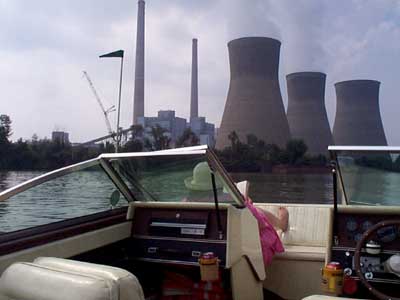 I
have a neighbor, Bud Turner, a few houses up river from me who puts on a big
to-do on the fourth with an impressive fireworks display in the evening. We
boated up to his house and watched the show from mid-river.
I
have a neighbor, Bud Turner, a few houses up river from me who puts on a big
to-do on the fourth with an impressive fireworks display in the evening. We
boated up to his house and watched the show from mid-river.
The town of Saint
Albans had their fireworks show on Saturday the fifth, in conjunction with their
River Fest, so we boated up there for another dose that evening. There were lots
of boats in the river and I kept the engine at idle and kept busy trying to hold
my position and avoid traffic. I should have just anchored off to the side like
a lot of other people, but I'd never used my anchor and was skeptical of trying
to learn how to use it with a boat full of guests in the middle of a crowd of
other boats. I took the boat out the following day and practiced anchoring so I
wouldn't find myself in that situation again.
 The
starting problem had reappeared a couple of times, and that Saturday
morning after the fourth it stayed bad long enough to do some troubleshooting. I
found that no power was getting to the starter motor.
The
starting problem had reappeared a couple of times, and that Saturday
morning after the fourth it stayed bad long enough to do some troubleshooting. I
found that no power was getting to the starter motor.
There are two relays, or
solenoids, in my starting system. There's a big one, the size of a soda can,
piggybacked on the starter motor that moves the starting gear into place in
addition to supplying power to the starter motor. The other one is smaller and
supplies power to the big solenoid when the key is turned to the starting
position. The little solenoid turned out to be the problem, which was a relief
considering the price of a new starter. Rather than try to find a replacement on
a holiday weekend, I disassembled the solenoid by drilling out the rivets that
hold the mounting plate on and cutting off the crimp connectors on the wires
that connect the external terminals to the coil windings. After getting inside,
I found the contacts to be severely corroded. I cleaned them up and reassembled
the solenoid, using a solder joint to replace the crimp connections for the coil
windings. It worked nicely, but I went ahead and bought a proper replacement
from WV Marine a few days later and installed it.
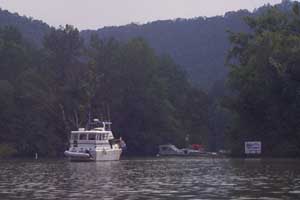 The
next Saturday, the twelfth, I changed out the zinc anodes to try to keep
corrosion from setting in again. I'd had the boat in the water for three or four
weeks by then and I wanted to see if the zincs were insulating
themselves as they had done previously. I also needed to get the trim tab
adjusted to straighten out the left turning tendency. To save myself the trouble
of taking the boat out of the water, I went up river to a place where there's a
sandy bank and tied off there so I could work on the drive unit while standing
in knee deep water. I put the clean trim tab on and angled it a little farther
in the clockwise (as viewed from the top) direction.
The
next Saturday, the twelfth, I changed out the zinc anodes to try to keep
corrosion from setting in again. I'd had the boat in the water for three or four
weeks by then and I wanted to see if the zincs were insulating
themselves as they had done previously. I also needed to get the trim tab
adjusted to straighten out the left turning tendency. To save myself the trouble
of taking the boat out of the water, I went up river to a place where there's a
sandy bank and tied off there so I could work on the drive unit while standing
in knee deep water. I put the clean trim tab on and angled it a little farther
in the clockwise (as viewed from the top) direction.
The anodes that I took off were discolored, but weren't completely insulated
yet. They were getting resistive, though, and depending on where I put the meter
probes I could measure anywhere from a few hundred ohms to several megohms.
There was no visible corrosion on the drive, which supports my theory that the
anodes will protect the drive for a while before eventually becoming
electrically insulated and ineffective. Of course, part of my corrosion
reduction could be attributed to the better paint job so my results are still
not conclusive, but the theory sounds plausible enough.
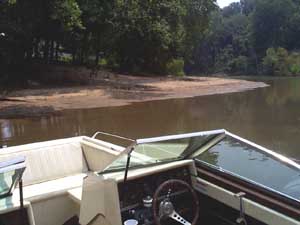 One
Sunday afternoon in July, Laura was visiting her mother and the boys were into
other things, so I took the boat back up the Coal River in Saint Albans and went
past the point where Laura and I had gone the previous year. My niece, Angie,
lives on the Coal and I found her house just a little past where we had turned
back. The river is very shallow at that point and I met a coworker, Mike Henley,
who was there on his jet ski. I asked him about the depth and he stepped off the
jet ski into water that was just a little above his ankles. I waded ashore, tied
the boat off to a tree and had a brief visit with my niece. I had taken it
slowly on the way there and after seeing how shallow the water was, I was even
more cautious on the way out. Mike told me that there used to be barge traffic
on the Coal and that there was a channel, but it's a little hard to find it
nowadays. I saw a lot of people in bigger boats than mine going up and down the
Coal River at high speed, but I had plenty of time and didn't want to take
chances so I just putted along listening to the NASCAR race at Pocono on my
radio.
One
Sunday afternoon in July, Laura was visiting her mother and the boys were into
other things, so I took the boat back up the Coal River in Saint Albans and went
past the point where Laura and I had gone the previous year. My niece, Angie,
lives on the Coal and I found her house just a little past where we had turned
back. The river is very shallow at that point and I met a coworker, Mike Henley,
who was there on his jet ski. I asked him about the depth and he stepped off the
jet ski into water that was just a little above his ankles. I waded ashore, tied
the boat off to a tree and had a brief visit with my niece. I had taken it
slowly on the way there and after seeing how shallow the water was, I was even
more cautious on the way out. Mike told me that there used to be barge traffic
on the Coal and that there was a channel, but it's a little hard to find it
nowadays. I saw a lot of people in bigger boats than mine going up and down the
Coal River at high speed, but I had plenty of time and didn't want to take
chances so I just putted along listening to the NASCAR race at Pocono on my
radio.
Next: Propeller Trouble
Index