A Few More Repairs
In addition to the shift shaft, I bought new zinc anodes and some zinc chromate primer and some black
paint for the outdrive's topcoat. My outdrive had a lot of white powdery blisters on it. I believe this is
due to galvanic corrosion. I read all the information I could find on the
subject. Most of the information that's available refers to corrosion problems
in salt water. Galvanic corrosion occurs on boat drives because they're made up
of dissimilar metals which are immersed in an electrolyte: a battery of sorts.
Metals are electrically active and the steel parts of my outdrive exchange
electrons with the aluminum parts generating small electric currents. The
trouble with that is that the aluminum is on the losing end of the exchange and
corrodes.
 To help reduce corrosion my drive has sacrificial zinc anodes consisting of a
zinc trim tab above the propeller and a couple of large bullet shaped zinc nuts
on the transom. The theory behind this is that these zinc parts are more
attractive to the galvanic currents than the aluminum, so they do the corroding
instead of the important and expensive aluminum parts. Some makers also produce magnesium anodes which
are supposed to work better in fresh water. It's all very scientific and has to
do with different metals being more or less noble, or cathodic/anodic,. These characteristics can be plotted on a "galvanic scale"
and the farther apart two metals are on the scale, the more susceptible the anodic one will
be to corrosion when you stick the two in an electrolyte, like
water. Stainless steel, which my propeller, fasteners, shafts and so forth are
made of, is way up on the cathodic end of the scale. My drive's housing is made
of aluminum, which is way down on the anodic end. Zinc is even more anodic than
aluminum, so it should be the big loser in the galvanic war.
To help reduce corrosion my drive has sacrificial zinc anodes consisting of a
zinc trim tab above the propeller and a couple of large bullet shaped zinc nuts
on the transom. The theory behind this is that these zinc parts are more
attractive to the galvanic currents than the aluminum, so they do the corroding
instead of the important and expensive aluminum parts. Some makers also produce magnesium anodes which
are supposed to work better in fresh water. It's all very scientific and has to
do with different metals being more or less noble, or cathodic/anodic,. These characteristics can be plotted on a "galvanic scale"
and the farther apart two metals are on the scale, the more susceptible the anodic one will
be to corrosion when you stick the two in an electrolyte, like
water. Stainless steel, which my propeller, fasteners, shafts and so forth are
made of, is way up on the cathodic end of the scale. My drive's housing is made
of aluminum, which is way down on the anodic end. Zinc is even more anodic than
aluminum, so it should be the big loser in the galvanic war.
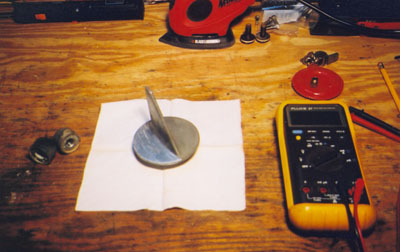 Out of curiosity, I took my trusty Fluke meter, set it to measure resistance and stuck the
probes on either side of one of my old zinc anodes. It measured infinite resistance,
an electrical insulator in other words. I scratched the pointy ends of the
probes into the surface and no matter how hard I scratched I couldn't get a
resistance of less than 10 MΩ, still very high. "Maybe they're not supposed
to have the texture and color of Lava soap," I thought. I took a file and cleaned an area of the
surface down to shiny metal and tried the probes again. Zero ohms. My zinc
anodes had developed an insulating layer on their surface. They couldn't have
been doing anything to reduce corrosion. The replacements were shiny and have
very low electrical resistance. A local shop suggested I replace my stainless steel propeller with an aluminum one to cut down on my corrosion problems, but
since that's a somewhat expensive proposition, I decided to try a fresh coat of paint on
the drive and the new anodes first. I painted my propeller, black to match
everything else, although I've been told that keeping paint on a boat's
propeller is next to impossible.
Out of curiosity, I took my trusty Fluke meter, set it to measure resistance and stuck the
probes on either side of one of my old zinc anodes. It measured infinite resistance,
an electrical insulator in other words. I scratched the pointy ends of the
probes into the surface and no matter how hard I scratched I couldn't get a
resistance of less than 10 MΩ, still very high. "Maybe they're not supposed
to have the texture and color of Lava soap," I thought. I took a file and cleaned an area of the
surface down to shiny metal and tried the probes again. Zero ohms. My zinc
anodes had developed an insulating layer on their surface. They couldn't have
been doing anything to reduce corrosion. The replacements were shiny and have
very low electrical resistance. A local shop suggested I replace my stainless steel propeller with an aluminum one to cut down on my corrosion problems, but
since that's a somewhat expensive proposition, I decided to try a fresh coat of paint on
the drive and the new anodes first. I painted my propeller, black to match
everything else, although I've been told that keeping paint on a boat's
propeller is next to impossible.
With the drive newly painted and the oil leak patched up, the old Thunderbird
was operable again. I've tried to find information on this boat, a copy of an
owner's manual or something, but there doesn't
seem to be much available. The company that made my boat somehow morphed into Formula
Boats around 1979. They still use the Thunderbird logo and curiously
sometimes refer to themselves as Thunderbird on their web site. I emailed them
to see if they had any info, but they replied that nothing was available on my
old boat.
I wanted to clean up a few loose ends while the boat was in drydock, so I
removed the AM/FM cassette deck which had recently stopped working. It wasn't
working very well before it quit altogether anyway. Maybe I'll put an up to date model with a CD player in
eventually.
I took the fuel gauge sending unit out to see if I could get it to actually
indicate the amount of fuel in the tank. The sender is a wirewound variable
resistor attached to a float. It was coated with the same kind of crud that was
in the carburetor. Prior to cleaning, it read various resistances as the float
moved. After cleaning it's reasonably linear from about 300 ohms at the
empty position to about 30 at the full position. I hooked the wires up and with
the sender still out of the tank watched the gauge follow the position of the
float lever just as it should. I measured the depth of the tank and found that
it's about an inch more than the float lever's throw. The gauge is going to read
empty when there's still a bit more than an inch of fuel left in the tank.
There's not much I can do about it and maybe it's a good thing anyway. The gasket
under the sending unit crumbled when I
removed it, so I bought some gasket material from NAPA and made a new one prior
to reinstalling. It didn't leak after refilling, so I guess I'm okay.
We launched the boat again on a Saturday morning in early October. I tried to pull
the truck forward on the ramp to straighten up at
one point but the clutch went into slip mode again and wouldn't pull the boat
uphill. It was straight enough, so I went ahead and launched. When I tried to
start the boat, I heard the starter solenoid click, but the starter motor didn't
turn. I clicked the key back and forth between run and start and after a few
clicks the starter engaged and the engine started right up. An inauspicious
start, but there were no further problems, so I chalked the starting problem up
to a weak battery and determined that I was going to have to do something about
the clutch problem.
Next: New Tow Vehicle
Index