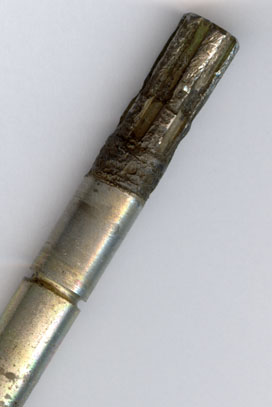
Failure
On a Friday evening, Laura nervously drove the boat to the public ramp at Poca (she'd never been in it alone before) and I met her there with the truck and trailer. Everything was going fine until I tried to raise the outdrive. It wouldn't budge. The down button would make the hydraulic pump whirr, but the up buttons had no effect. (There are two up buttons. One raises the drive to the maximum safe running height. Pushing both at the same time raises it beyond that point to the trailering position.) A couple of young guys with a small fishing boat showed up and I explained that we were having problems. They went ahead and launched their boat (it's a wide ramp) and tied it up at the dock. They came back and offered to help. We decided to try and pull the boat up out of the water with the drive down and then deal with the outdrive on land. I was trying to ease forward to avoid dragging the drive and overheated the truck's clutch. I had plenty of power, but I couldn't get it to the wheels. We let the clutch cool off for a few minutes and this time we made it up the ramp, with the two fishermen pushing. The skeg (the fin on the bottom of the drive) was about two inches above the pavement.
We disconnected the trim cylinders from the drive, lifted it, and tied it up
with a rope for the trip home. The next day, I traced the trim wiring and found
that a switch on the reverse lock valve was open. The switch is there to prevent
you from raising the drive while you're running in reverse because that would
put a lot of stress on the cylinders. I'm not sure why the switch was stuck, but moving the lever
all the way to full reverse and back fixed it. I wished I'd known to do that the
previous night.
I drained the drive oil, finding about a tablespoon of water in it, and then I took the lower half of the drive off again. The lower unit removal and installation process was getting to be as familiar as taking off my shoes and putting them back on. (I'm from West Virginia, so maybe that doesn't mean a whole lot.) I rigged up my pressure test setup, pumped in some air, and watched pressurized air and oil spew out around the shift shaft. This time I had no choice but to remove the shaft. It turned out that shift crank didn't want to go anywhere down in the inaccessible part of the drive and the shift shaft came out with no problems. What I'd thought was discoloration was actually heavy corrosion on the shaft, right at the place where it goes through the seal.
I ordered a new stainless steel shaft and seal. I read that they started putting stainless steel shafts in Mercruiser drives in 1977. Mine had one of the older, plain steel ones. While I was at it I picked up that special wrench for the seal bushing and a real pressure test gauge. I put the new shaft and seal in, a job made much easier with the right tool, and did a pressure test with my new gauge. So far, so good.