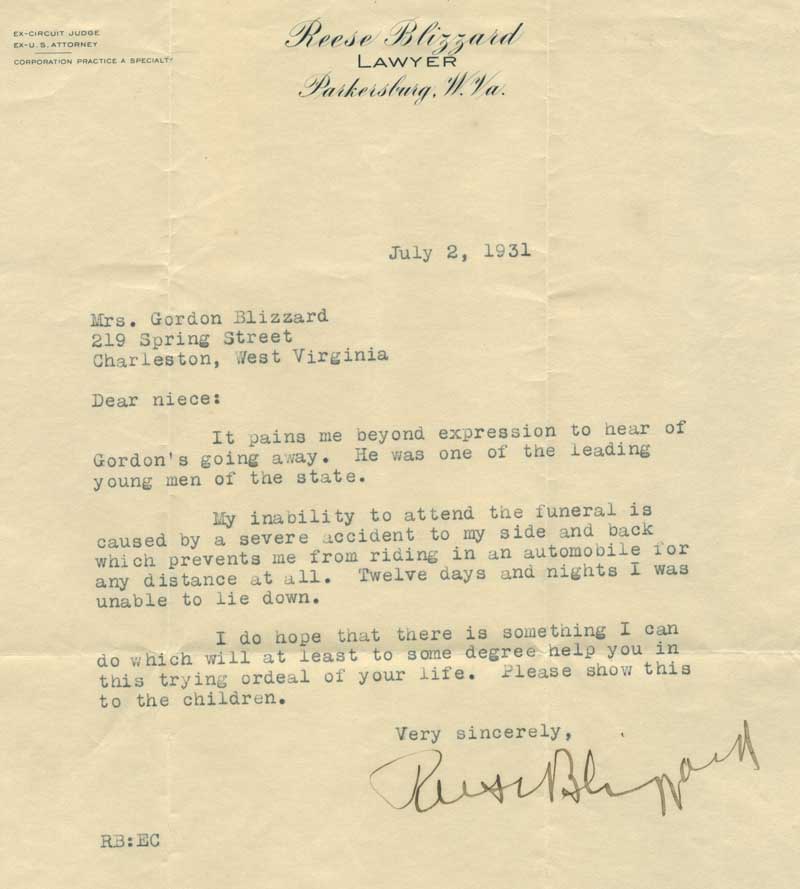
Letter from Reese Blizzard to Lena, RE Gordon's funeral.
 The History of West Virginia, Old and New
Published 1923, The American Historical Society, Inc.,
Chicago and New York, Volume III, pg. 4-5
REESE BLIZZARD. Considering the broad range of his services and activities Reese
Blizzard, of Parkersburg, has lived an exceedingly busy life, and his friends
have many times admired the wonderful energy which he has put into his
undertakings. He is one of West Virginia's distinguished lawyers, formerly a
circuit judge, and has also been a constructive factor in the larger business
affairs of the state.
Judge Blizzard was born in Nicholas County, West Virginia, October 17, 1864, son
of James and Elizabeth (Gill) Blizzard. His maternal grandfather came to this
country from Ireland. His paternal grandfather, Alexander Blizzard, came from
Scotland. His wife was a Campbell, also of Scotch ancestry and related to
Alexander Campbell, founder of Bethany College, West Virginia. Alexander
Blizzard made his home in New Jersey. James was one of his three sons, one of
whom went to Ohio and the other to Indiana, while James settled in Greenbrier
County, West Virginia. He was a clergyman of the Methodist Protestant Church,
though his duties were only local. The greater part of his life was spent in
West Virginia, and he was a private soldier in the Confederate army and wounded
in the battle of Shiloh. He died in 1889 and his widow in 1907. James Blizzard's
first wife was a daughter of Rev. A. T. Morrison, of Nicholas County, and she
became the mother of ten children. His second wife, Elizabeth Gill, was the
mother of thirteen children.
Reese Blizzard lived in Nicholas County until he was thirteen, and thereafter
made his home with his parents in Gilmer County until he reached his majority.
Following that he spent some time in Calhoun County, and eventually came to Wood
County. His education was the product of common schools, and the Glenville
Normal School at Glenville in Gilmer County. Among the experiences by which he
made a living and prepared himself for bigger things he taught school, worked on
a farm, clerked in a store, was assistant in the circuit clerk's office and
carried mail. He read law at Glenville with the firm of Linn & Withers, and was
admitted to the bar in 1886. Beginning practice at Grantsville, he was soon
recognized as a man of superior powers in the law and his practice came to
extend all over Central West Virginia. Ten years after his admission to the bar
he was elected circuit judge of the Sixth Judicial Circuit in 1896. The circuit
was composed of the counties of Gilmer, Calhoun, Roane, Jackson and Clay. As
judge of that court he made the court a purely business machine, and attracted
the attention of the entire state by the rapidity with which he transacted the
business of the court. He was only reversed twice by the Supreme Court during
his entire term of office—a record never made by any other judge in the state.
Judge Blizzard served only four years of his eight-year term, resigning midway
to remove to Parkersburg and engage in the general practice of the law.
In 1901 he was appointed by President McKinley United States district attorney
for the State of West Virginia. Soon after this the state was divided into two
districts, and Judge Blizzard was made district attorney to the Northern
District. He was reappointed by President Roosevelt, and had charge of all
matters in his district under the Federal Department of Justice until 1910. For
ten years he was attorney for the Street Railway Company of Parkersburg. He has
served as attorney for the Little Kanawha Syndicate Properties, and in that
capacity directed the condemnation proceedings for the right of way from the
Pennsylvania state line to Fairmont for the Buckhannon & Northern Railroad.
Judge Blizzard is president of the Parkersburg Commercial Banking & Trust
Company, president of the Parkersburg Ice Company, president of the Oil & Gas
Company, and has many other business interests too numerous to mention. His
chief hobby outside the practice of law is farming, and his home is on a
beautiful suburban place at Parkersburg. He has given considerable attention to
the breeding of pure bred livestock, chiefly horses. Judge Blizzard has been
directly connected with the building of five fair grounds in West Virginia, the
last one being at Parkersburg, said to be the best in the state. He was
president of the Parkersburg Fair Association for many years.
In politics he has always been a loyal republican. The five counties in the
Sixth Judicial Circuit had a normal democratic majority of 1,372. In that
circuit he was elected to the judgeship by 819 majority.
In 1904 Judge Blizzard was in the storm center of the politics of West Virginia.
The late A. G. Dayton, W. P. Hubbard, George 0. Sturgiss and Judge Blizzard were
agreed upon as a committee to make recommendations to the Legislature for the
enactment of laws after the storm produced by the report of the West Virginia
Tax Commission.
As a member of this committee Judge Blizzard proposed many laws that had not
been recommended by the tax commission and which were afterward enacted as laws
by the Legislature. As a result, leaseholds for oil, gas and coal have been
taxed ever since. The fees of state officers, and especially that of secretary
of state, amounting to $60,000 per year, has been turned into the state
treasury. Capitation taxes have been collected by the assessor when assessment
is made. This has netted the state treasury something like $100,000 per year. In
all, more money has been turned into the state treasury as a result of these
recommendations than was turned in as a result of the recommendations of the
State Tax Commission.
But the real character and public interest of the man was more clearly shown in
the ownership and editorial management of the Parkersburg Dispatch News, a daily
newspaper, than in any other phase of Judge Blizzard's life. It was in this that
his independence and fearlessness were displayed in a most remarkable degree.
He was one of the earliest, if not the very earliest, progressive republicans in
West Virginia. As editor of the Parkersburg Dispatch News he was a most
unwavering advocate of Roosevelt's principles and policies. In some matters he
was in advance of Roosevelt. While he stoutly opposed strikes as a means of
settling differences between capital and labor, he even contended that capital
was worse than labor for making conditions which brought about strikes. His
doctrine was that if the great body of the people knew that labor would not
strike it would be much more friendly to labor, and that if labor would put into
politics the money it put into strikes in properly setting itself before the
public that it would, with the masses favoring it, be able to enact laws which
would prevent capital from being unfair. He constantly proclaimed that the
insignificant number of capitalists and the small number of organized, labor
ought not to be permitted to disturb the great body of the people; and that the
people, being disinterested and fair should make such laws as would prevent the
great body of the public from being disturbed, harassed and injured by a fight
between capitalists, composed by not more than five per cent of the people, and
organized labor, constituting not more than fifteen per cent of the people. He
urged that at the beginning of the existence of civilized man capital and labor
began the settlement of their differences by the same method that two bullies
employ by trying which are the stronger. It has settled nothing: it has
constantly become worse. That the real solution of the problem is in eliminating
the difference between capital and labor by making the great masses both
capitalists and laborers. That there was no law, moral or divine, which of right
would constitute one man a laborer and another a capitalist. That, without
revolution or seriously disturbing business, and by a system of inheritance and
income taxes, the enormously few estates of the country, composing ninety per
cent of its wealth, could in twenty-five years redistribute ninety per cent of
the wealth of the country; and that the money thus derived should be employed in
paying all of the expenses of educating all of the children of the country; and
in the construction of our permanent public roads, thus relieving the masses of
the great burden of taxation; that the same authority which voted out of
existence the liquor power because it was against the public interest could,
with the same license, redistribute the enormous holdings of the few, because
such holdings are against the public interest.
His first wife was Lillie Stump, who died in 1896. The four children by that
union were Reese, Jr., Boy, Pearl and Ethel. Judge Blizzard then married Fannie
Holland, and they have three children, named Paul, Pansy and Fannie. Two of his
sons, Reese, Jr., and Paul, made creditable records during the World war, both
seeing service abroad.
By a system of strenuous exercises and by using milk as the greater part of his
diet, Judge Blizzard has rebuilt a constitution worn by work that, fifteen years
ago, seriously threatened his life, and he is now a stronger and more rugged man
and capable of performing much more labor than he has been since he was thirty
years of age.