|
The History of Vernors
Our Nations oldest soda is Vernors Ginger Ale, and it was created over 130 years ago. Many of today's soft drinks take an understandable pride in their histories, but they all must bow to Vernors.
In 1858, a 15-year old boy, named James Vernor, started working at Higby and Sterns' Drug Store as an errand boy. He was obviously a pretty sharp young man as he quickly worked his way up to Junior Clerk, and would eventually go on to help pass the state's first pharmacy law and would also sit on the State Board of Pharmacy for eight years.
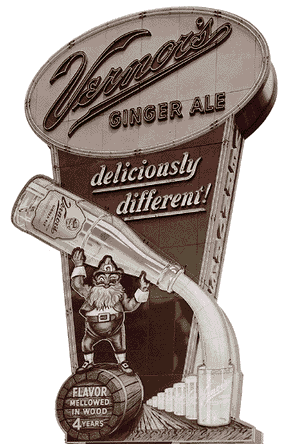
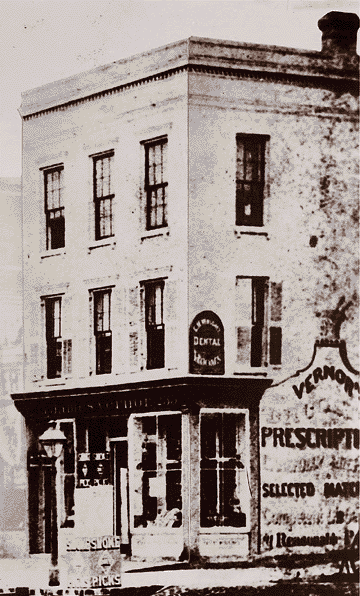
A golden colored ginger ale was being imported from Belfast, Ireland and was becoming quite popular throughout the United States (ginger ale would be the nations most popular soft drink for about seventy years). A nineteen-year-old James Vernor began experimenting with his own ginger ale recipe. However, like many young men his age, during 1862 in Detroit, he put his plans on hold and enlisted as a Union soldier with the Fourth Michigan Cavalry. Before leaving for war though, James placed his experimental ginger ale extract into an old oak cask. At the end of the Civil War, James would return home and open a drug store of his own at 235 Woodward. Another thing that James opened was that old oak cask. To his surprise, the four years of aging blended a select group of secret ingredients to perfection.
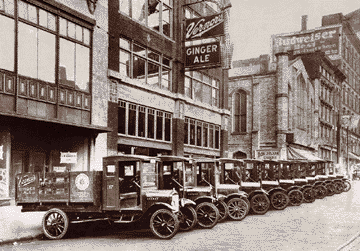
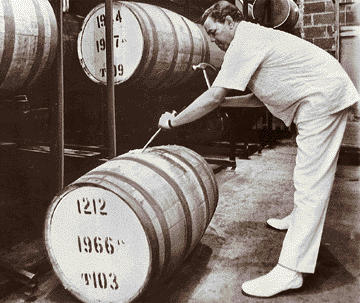
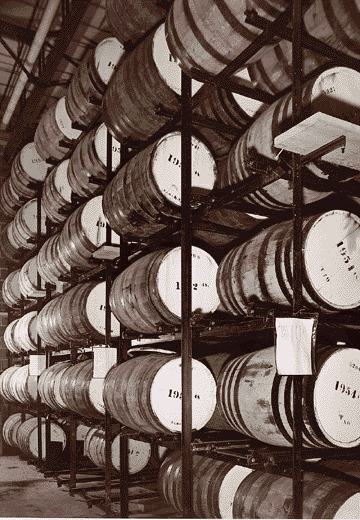
Mr. Vernor would offer his ginger ale to his drug stores soda fountain patrons for the next thirty years (all good drug stores had a soda fountain) However, Vernor's Ginger Ale was not an overnight success (at least not on a large scale). In fact, it would not be until 1896 that enough business was being generated from the sale of ginger ale that Mr. Vernor was able to close his drug store. Mr. Vernor opened a small plant at the foot of Woodward Avenue just a few doors down from his old drug store. It was here that Mr. Vernor, along with his nineteen-year-old son, James Vernor II, (the companies only employee) blended, aged, bottled, and distributed Vernor's Ginger Ale. You may have noticed that I said "aged" that is because Vernors Ginger Ale extract was still aged in oak cask for four years before it was ever used to produce the soft drink. This process of aging in oak would continue until at least the 1980's, and for all I know the current bottlers may still be aging the extract.
|
The Standard Manual of Soda and Other Beverages
Dr. Emil Hiss -- 1897
Ginger ale extract,Vernor's.....fl.oz.
4
Sugar, granulated...............av.lb. 9 ½
Solution of citric acid..............fl.dr. 4
Water, filtered..........................gal. 10
Dissolve the sugar in the water cold, add the
solution of citric acid and the extract, and strain through cloth into the
fountain and charge with carbonic acid gas to 120 pounds.
Cost, $1.00. Retail in 12-ounce glasses $6.00
--James
Vernor, Detroit, Mich. |
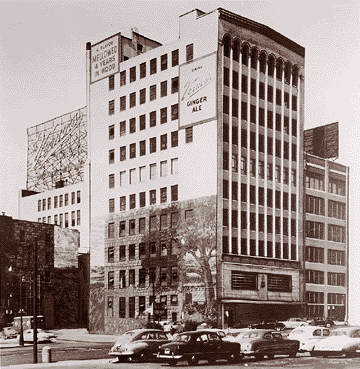
Over the next few decades Vernor's Ginger Ale would grow by leaps and bounds. It would become the ginger ale that all other ginger ales were judged. Most bottlers had some type of specialty product that differentiated them from their competitors (like Cherry Nip, or Dr. Flints Julep), but they all went head to head with their ginger ales. For Vernors to dominate the market the way that he did was a huge (and I mean HUGE) deal. James Vernor became synonymous with ginger ale, and in fact, a publisher of a soda fountain formulary guide even included a ginger ale formula in his guide that used Mr Vernor's extract. Until a little after 1920 ginger ale had been our nations most popular style of soda. What happened? How did ginger ale lose its popularity?
Prohibition killed golden ginger ale. In the 1920's Americans were visiting illegal speakeasies in droves, and the cocktail was at the height of fashion Many soft drinks were used as a mix with alcohol, and there was even one specifically made to mix with alcohol. It was called "dry" ginger ale (colorless, almost tasteless, and less sweet than golden ginger ale). During prohibition, dry ginger ale became immensely popular. However, golden ginger ale quickly fell off in popularity, as all forms of ginger ale would become associated with liquor in the non-drinking public's mind.
On March 20, 2001 the Byrnes Building on the corner of Grand
River Avenue and M.A.C. Avenue in downtown East Lansing was demolished. The
demolition exposed several painted advertisments on the west side of the D.S.
Brown Building (307 E. Grand River) that had been painted in the early 1950s and
then covered by the construction of the Byrnes Building in the late 1950s. The
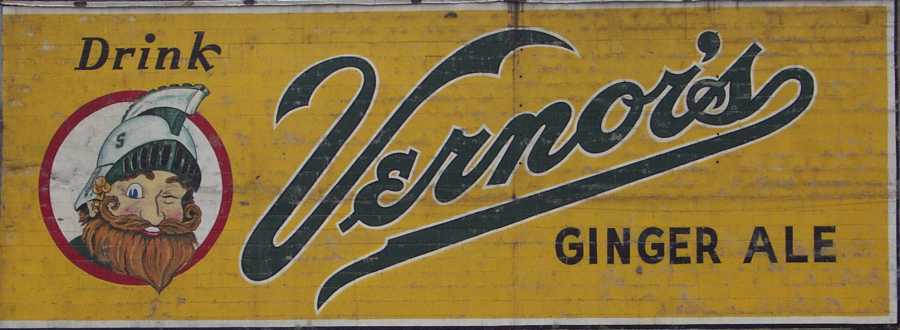
largest ad, covering over half of the wall, was for Vernor's Ginger Ale. It
features the large Vernor's script logo and the Vernor's Gnome (note the Spartan
Helmet on the Gnome). It was painted by Dyer Company employee Ray Myers (b.
1928).
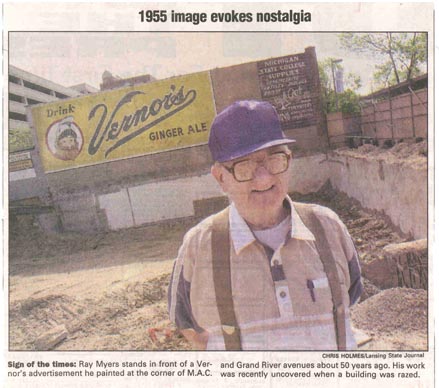
73-year-old creator says he talked of day ad would be revealed
Painter of Vernor's sign knew it would be found
By Jessie De La Cruz Lansing State Journal
EAST LANSING -- Almost 50 years ago, Ray Myers went out on a routine
assignment to paint a Vernor's ginger ale advertisement on the corner of M.A.C.
and Grand River avenues.
Today, that handiwork has new life as a local attraction and piece of
nostalgia of a forgotten era. For Myers, 73, it is also a vivd image of the
beginnings of his sign-painting career.
He considers it one of his best signs, although it was covered only a few
months after he painted it in 1955.
The sign re-emerged in February, when the Byrnes Building that protected it
was razed to make way for the $30 million City Center development. "It was
like digging up old bones," said Myers, a lifelong Lansing resident.
"We've even said if they ever tear the building down, there it will be --
and it was."
Some people want to preserve the sign, perhaps through an acrylic or glass
window of the new building. If that doesn't happen, it's likely to be covered by
the end of June.
It took a few days for Myers to paint the sign, from putting the primer on to
filling the charcoal powder outline that would later be colored. "I painted
Vernor's walls all around Lansing," said Myers, who worked for the Dyer
Company at the time. "The only difference was on this one we put a little
Sparty hat on [the gnome]."
The Vernor's sign has become a topic of many conversations at the Curious
Book Shop, which is in the building the sign is on. Owner Ray Walsh wants to
make a postcard from a picture of the sign that was dropped off at his store.
"It's a vanished East Lansing," Walsh said.
The 1955 sign was not unusual for its time. Hand-painted advertisements
decorated many buildings in the Lansing area and nationwide. It's the nostalgia
of the Vernor's sign that makes it important to local people, said Janice
Bukovac, assistant professor in the advertising department at Michigan State
University. "I think for a lot of people that is old East Lansing,"
she said. "That in and of itself is a very important value of the community
and people of this area." Bukovac said the old-fashioned style of
advertising also has become popular as an art form.
In Flint, the Greater Flint Arts Council has raised money several times over
the past 30 years to save a three-story Vernor's advertisement on its office
downtown. The mural, painted in 1932, features the Vernor's gnomes storing soda
syrup in oak barrels and taking them to their castle. "It has that
fairyland appeal to the young people," said Greg Fiedler, the council's
executive director. "It's always been a community attraction."
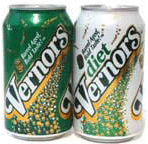
How to Make a Boston Cooler, Michigan Style
Don't worry about the 'Boston'
reference. This is a concoction that is uniquely Michigan, thanks to that
magical ginger ale, Vernor's.
Here's How:
Open a 12-ounce can of Vernor's Ginger Ale. Positively no substitutions are
allowed. Pour the Vernor's in a blender. Add two large scoops of vanilla ice
cream. Lick your lips in anticipation. Add one tablespoon of vanilla extract.
Turn on blender; mix till thick, creamy and wonderful. Pour into a frosted
glass. Try not to burst into blissful song as you enjoy your Michigan Cooler.
Tip: Never ever ever use Canada Dry ginger ale, or any other brand.
|